
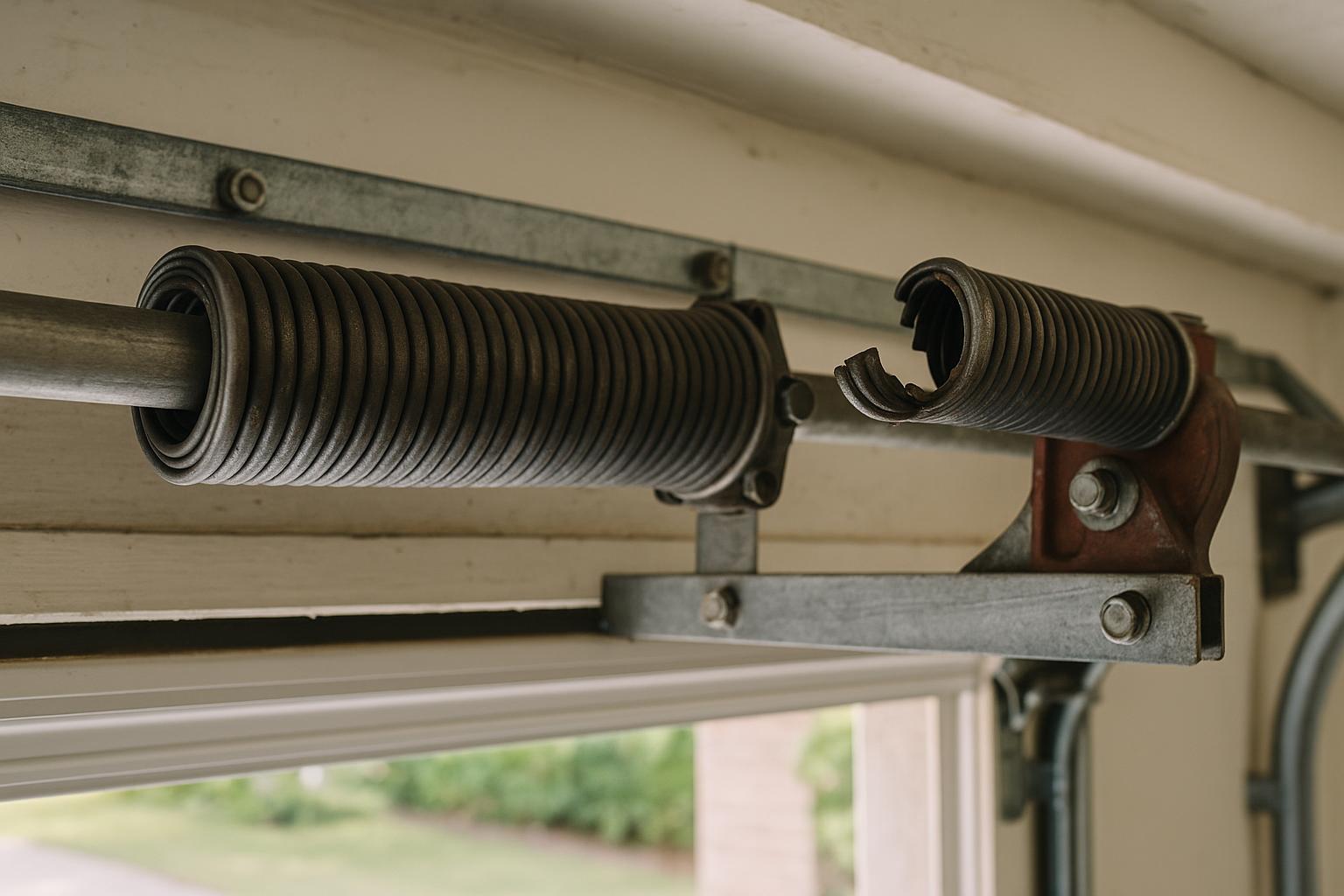
One Spring Broke — Do You Really Need to Replace Both?
It's a question we hear almost every day from homeowners across Toledo: one garage door spring just snapped, and now they're wondering whether they should save money by replacing only the broken one or go ahead and replace both springs at the same time.
It's a fair question. Nobody wants to spend more than they have to on a repair. But in most cases, replacing both springs is the smarter move — and it can actually save you money in the long run. Let's break down exactly why.
How Garage Door Springs Work in Pairs
Most residential garage doors in the Toledo area use a pair of torsion springs mounted on a metal shaft above the door. These two springs share the load of lifting and lowering your garage door, which can weigh anywhere from 130 to over 400 pounds depending on the size and material.
Because both springs were installed at the same time, they've endured the same number of cycles (one cycle equals one open and one close). They've weathered the same Toledo winters, the same humidity, and the same daily wear and tear. When one spring breaks, it means both springs have reached the end of their expected lifespan. The remaining spring is living on borrowed time.
Why Replacing Just One Spring Is Risky
Here's what happens when you replace only the broken spring and leave the old one in place:
- The old spring will likely break soon. If both springs were installed together, the surviving spring has the same amount of wear. Most technicians see the second spring fail within a few weeks to a few months after the first one breaks.
- Uneven tension causes problems. A brand-new spring paired with a worn-out spring creates an imbalance. One side of the door bears more weight than the other, which can cause the door to open unevenly, put extra stress on the opener, and wear out cables and rollers faster.
- You'll pay for two service calls instead of one. The labor to replace garage door springs is a significant part of the total cost. If you replace one now and the other breaks in two months, you're paying for a second trip, a second round of labor, and another disruption to your day. Replacing both at once means one service call, one labor charge, and one invoice.
The Cost Difference Is Smaller Than You Think
Many homeowners assume that replacing both springs costs twice as much as replacing one. It doesn't. The springs themselves are relatively affordable — it's the labor, the service call, and the expertise that make up the bulk of the bill.
When a technician is already on-site with the door disassembled and the tension released, adding the second spring takes only a fraction of the time it took to do the first. You're essentially paying for one extra part and a few extra minutes of work. Compare that to scheduling and paying for an entirely separate repair visit down the road, and the savings become obvious.
When It Might Be Okay to Replace Just One
There are a few scenarios where replacing a single spring could make sense:
- The springs were replaced at different times. If one spring was replaced more recently than the other, it may have significantly more life left in it. In that case, your technician can assess the condition of the newer spring and advise accordingly.
- Your door uses a single-spring system. Some lighter, single-car garage doors use only one torsion spring. In that case, there's only one spring to replace. This is common in some older homes in Sylvania and Holland.
- You're planning to replace the entire door soon. If a full garage door replacement is in your near future, it may not make sense to invest in two new springs on a door you're about to retire.
What About Extension Springs?
Some garage doors — particularly older models common in neighborhoods throughout Maumee and Perrysburg — use extension springs instead of torsion springs. These are mounted along the horizontal tracks on either side of the door. The same principle applies: if one breaks, the other is just as worn and should be replaced at the same time.
Extension springs can be particularly dangerous when they fail because they're under significant stretch tension. If your door uses extension springs and they don't have safety cables running through them, ask your technician about adding those during the replacement. It's an inexpensive safety upgrade that prevents a broken spring from becoming a projectile in your garage.
How Long Do Garage Door Springs Last?
Standard garage door springs are rated for approximately 10,000 cycles. For a household that opens and closes the garage door four times a day, that works out to roughly seven to eight years. High-cycle springs rated for 25,000 or even 50,000 cycles are available and can be a worthwhile investment, especially if your garage door is your primary entry point.
Toledo's climate also plays a role in spring longevity. The constant expansion and contraction caused by our temperature swings — from humid summers to freezing winters — can accelerate metal fatigue. Regular maintenance, including lubrication of the springs and other moving parts, helps extend their life.
Don't Try This Yourself
We can't stress this enough: garage door spring replacement is not a DIY project. Torsion springs are under extreme tension, and a mistake during removal or installation can cause serious injury or even death. Every year, emergency rooms across the country treat people who attempted to replace their own garage door springs.
A trained technician has the tools, the experience, and the knowledge to replace your springs safely and correctly. They'll also ensure the springs are properly balanced and calibrated for your specific door, which is critical for smooth operation and the longevity of your opener.
The Bottom Line for Toledo Homeowners
If one garage door spring breaks, replacing both is almost always the right call. You'll avoid a second breakdown, a second service call, and the headaches that come with an unbalanced door. It's one of those situations where spending a little more now saves you a lot more later.
At Toledo Garage Door, we're upfront with every customer about what we recommend and why. When we show up to your home in Toledo, Oregon, Perrysburg, or anywhere else in the area, we'll inspect both springs, explain your options honestly, and let you make the decision that's right for your budget and your situation. No pressure, no upselling — just straight talk and quality work.
If you've got a broken spring or you're hearing unusual sounds from your garage door, don't wait for a complete failure. Give us a call and we'll get it taken care of.